

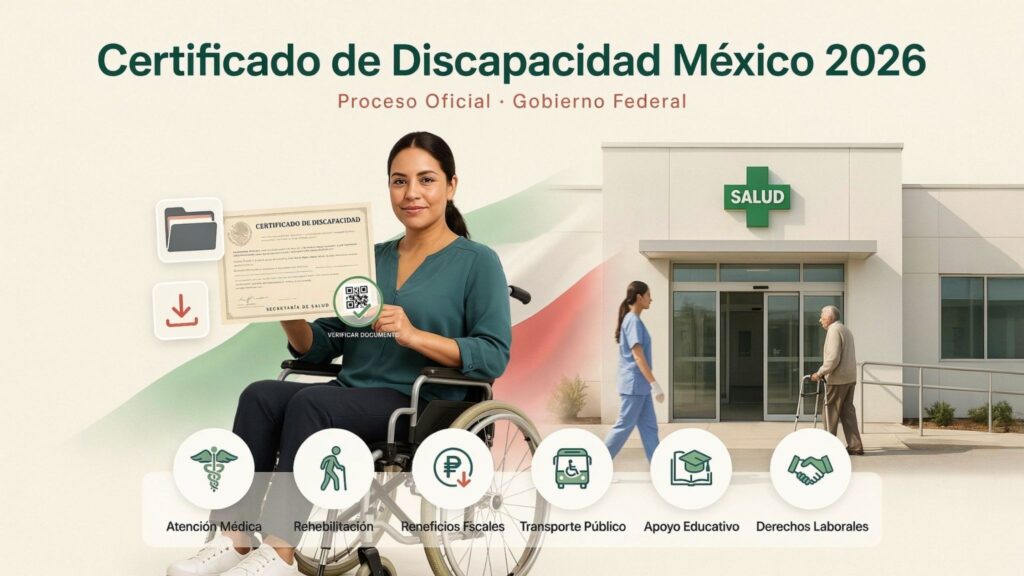
If you or a family member live with a long-term physical, sensory, intellectual, or mental health condition in Mexico, getting official recognition of that condition can open the door to real benefits — free rehabilitation, tax exemptions, transport discounts, and legal protection at work. That official recognition comes in the form of the Certificado de Discapacidad, Mexico’s national disability certificate.
This guide walks you through what the certificate is, who issues it, how the application process works at IMSS, DIF, and your local health center, what documents you’ll need, and what rights it unlocks once you have it.
What Is the Certificado de Discapacidad?
The Certificado de Discapacidad is an official document issued by a recognized Mexican health authority that formally certifies a person’s disability status. It’s sometimes also called the certificado médico de discapacidad permanente or certificado de invalidez, depending on the issuing institution.
Unlike a basic medical report from your doctor, this certificate carries legal weight nationwide. Once issued, it acts as the bridge between a medical diagnosis and access to:
- Health services and rehabilitation programs
- Tax exemptions and government subsidies
- Workplace protections and employment quotas for people with disabilities
- Discounted or free public transport
- Social housing support and home adaptations
- Specialized or inclusive education programs
In short, the certificate doesn’t just describe a medical condition — it’s the key that unlocks the rights and support systems Mexico provides to people with disabilities.
Who Qualifies? Types of Disabilities the Certificate Covers
Mexican health authorities recognize several broad categories of disability under this certificate:
Physical and motor disabilities — conditions affecting mobility and movement, such as advanced arthritis, severe scoliosis, amputations, paralysis, or chronic conditions like terminal kidney failure and uncontrolled diabetes with complications.
Sensory disabilities — significant or total hearing loss, blindness or severe uncorrectable vision loss, and combined sensory impairments (deafblindness).
Psychosocial and mental health conditions — severe and persistent conditions such as schizophrenia, bipolar disorder, incapacitating anxiety with agoraphobia, major depression, and autism spectrum disorder with significant functional limitations.
Intellectual disabilities — significant cognitive limitations that affect a person’s ability to function independently across multiple areas of daily life.
Multiple disabilities — any combination of the categories above (for example, a physical disability combined with a sensory one).
Conditions like fibromyalgia, epilepsy, lupus, and rheumatoid arthritis can also qualify, but only when they’re documented as causing a permanent, significant functional limitation — not simply based on having the diagnosis.
Where to Apply: Comparing Your Options
There’s no single national office that issues this certificate. Instead, several public institutions can issue it depending on your situation:
| Institution | Best For | Cost | Typical Timeline |
| IMSS | Active IMSS-insured workers and their dependents | Free | ~15–20 days |
| DIF | People without social security coverage, especially in rural areas | Free | ~20–30 days |
| Centro de Salud / Secretaría de Salud | General public, no affiliation required | Free | ~10–15 days |
| State portals (e.g., EDOMEX) | Residents of states with digital systems | Free | ~5–7 days after evaluation |
So, if you’re an active IMSS member, that’s usually the fastest route since your medical history is already on file. If not, your local Centro de Salud is typically the most accessible option — it’s open to everyone and doesn’t require any prior affiliation.
Step-by-Step: How to Apply
While the exact process varies slightly by institution and state, most applications follow the same general path:
1. Gather your existing medical documentation. Bring any prior diagnoses, lab results, imaging studies, or specialist reports related to your condition.
2. Choose the right institution. If you’re an IMSS policyholder, start with your family doctor at your assigned clinic. If not, locate your nearest DIF office or Centro de Salud.
3. Request a disability evaluation. At IMSS, your family doctor will refer you to a Junta Médica (medical evaluation board) if needed. At DIF and health centers, you’ll typically request the evaluation directly at the front desk.
4. Attend the medical evaluation. A doctor (or, at DIF, sometimes a small team including a social worker) will review your diagnosis, examine you, and document your functional limitations in detail.
5. Wait for the resolution. The evaluating board issues a formal medical opinion (dictamen médico) determining whether — and to what degree — you qualify.
6. Receive your certificate. Once approved, you’ll get a printed certificate and, in many cases, a digital PDF version with a verification QR code.
Tip: If you’re starting from a private specialist’s diagnosis, that’s fine — you can bring a private doctor’s report to a public institution, and they can use it as the basis for your evaluation, provided it includes a clear diagnosis, ICD-10 code, and description of your functional limitations.
Documents You’ll Typically Need
Requirements vary slightly by institution, but in general you should bring:
- Valid official ID (INE or passport)
- CURP (unique population registry code)
- Proof of address, no older than 3 months
- Prior medical diagnosis or records documenting your condition
- IMSS affiliation card (if applying through IMSS)
- Additional studies (X-rays, lab results) if available
If part of your goal in getting the certificate is to access tax exemptions or subsidies, it’s worth also having your fiscal documentation in order. Many of these benefits require you to be registered with Mexico’s tax authority (SAT), and having your imprimir constancia de situación fiscal on hand can help confirm your identity and tax status when you go to claim them.
What Benefits Does the Certificate Unlock?
Once issued, the Certificado de Discapacidad gives you access to a wide range of rights and support programs across several areas.
Health benefits include full coverage for rehabilitation services, free medication, assistive devices like wheelchairs and hearing aids, and physical, occupational, or speech therapy.
Employment benefits include legal protection against workplace discrimination, reasonable accommodations, access to protected employment quotas, job training programs, and in some cases reduced working hours with proportional pay.
Educational benefits include inclusive education in regular schools, access to specialized education centers when needed, support staff such as interpreters or aides, curriculum adaptations, and scholarships.
Fiscal and economic benefits include tax exemptions, priority access to housing subsidies, government aid programs, discounts on basic services, and funding for home accessibility adaptations.
Accessibility and social participation benefits include the right to accessible public spaces, reserved seating on public transport, and priority access in public services.
Validity, Renewal, and Getting a Digital Copy
Not all certificates are issued the same way:
- A permanent certificate is valid indefinitely and is issued for stable, chronic conditions.
- A temporary certificate is valid for 1–2 years and applies to conditions that may improve or are still progressing — these need to be renewed.
- Certificates for progressive conditions are typically reviewed annually.
Renewing your certificate generally takes 10–15 days and involves submitting updated medical documentation (no older than 6 months) and going through a shorter follow-up evaluation.
If your condition changes — whether it improves or worsens — you can request an extraordinary evaluation with new medical studies, and your certificate will be updated to reflect your current status.
Many state portals also let you download your certificate as a digitally signed PDF with a QR code for verification, which is just as legally valid as the printed version.
Tips for a Smoother Application
Start with whatever documentation you already have. Even an old diagnosis from years ago is useful — it gives the evaluating doctor a starting point and can speed up the process.
Choose the institution that matches your situation, not just the closest one. If you’re IMSS-insured, going through IMSS is usually faster than starting from scratch at DIF.
Ask specifically about the “Ventanilla de Discapacidad.” In Mexico City and several other states, health centers have a dedicated disability window that can fast-track your request.
Bring more documents than you think you need. Extra copies of ID, address proof, and medical records rarely hurt and often save you a second trip.
If your first application is denied, ask for the reasons in writing. This gives you a clear roadmap for what additional documentation to gather before appealing.
For children, expect slightly different requirements. Applications for minors usually require the parent or guardian’s ID, the child’s birth certificate, and recent photos, in addition to medical records.
Keep both digital and printed copies once issued. Some benefits programs accept digital PDFs, while others (like certain employer processes) may still ask for a physical, stamped copy.
Mark your renewal date on a calendar. Temporary certificates lapse quietly — don’t wait for a rejection notice from a benefits program to discover yours expired.
Frequently Asked Questions
Is the Certificado de Discapacidad mandatory? No. It’s voluntary, but without it you can’t formally access the benefits and protections described above.
How much does it cost? Nothing. IMSS, DIF, and the Secretaría de Salud all issue it free of charge.
What’s the difference between a temporary and a permanent certificate? A permanent certificate is for stable, lifelong conditions and never expires. A temporary one is for conditions that may change and is valid for 1–2 years.
Can I apply using a diagnosis from a private doctor? Yes. Public institutions can use a private specialist’s report as the basis for your evaluation, as long as it’s detailed enough.
Where can I apply if I’m not affiliated with IMSS? DIF offices and your local Centro de Salud / Secretaría de Salud both accept applications from the general public, with no affiliation required.
Can residents of the State of Mexico apply online? Yes — EDOMEX has a centralized online portal where you can register, upload documents, and schedule your in-person evaluation.
Does fibromyalgia qualify for the certificate? It can, if a rheumatologist documents persistent pain and incapacitating fatigue lasting more than three months that limits daily activities.
Can I have more than one certificate? No. You should only have one valid certificate at a time. Renewals and updates replace the previous version.
Will having this certificate affect my job or privacy? The certificate isn’t published automatically. It’s only seen by institutions you choose to share it with — such as employers, schools, or benefits programs.
How do I check if my certificate is still valid? Check the issue and expiration dates on the document itself, verify the QR code if it has one, or confirm directly with the institution that issued it.
Final Thoughts
The Certificado de Discapacidad is more than paperwork — it’s the legal foundation that connects a medical diagnosis to real-world support: healthcare, education, employment protections, and financial relief. If your condition (or that of a family member) meets the criteria, the process is free, and in most cases faster than people expect.
Start with the institution that matches your situation — IMSS if you’re already affiliated, or your nearest Centro de Salud or DIF office if not — bring your existing medical records, and don’t be discouraged if the first evaluation doesn’t go as planned. Renewals, appeals, and updates are all part of a normal process that ultimately puts a legal tool in your hands to claim the rights you’re entitled to.
